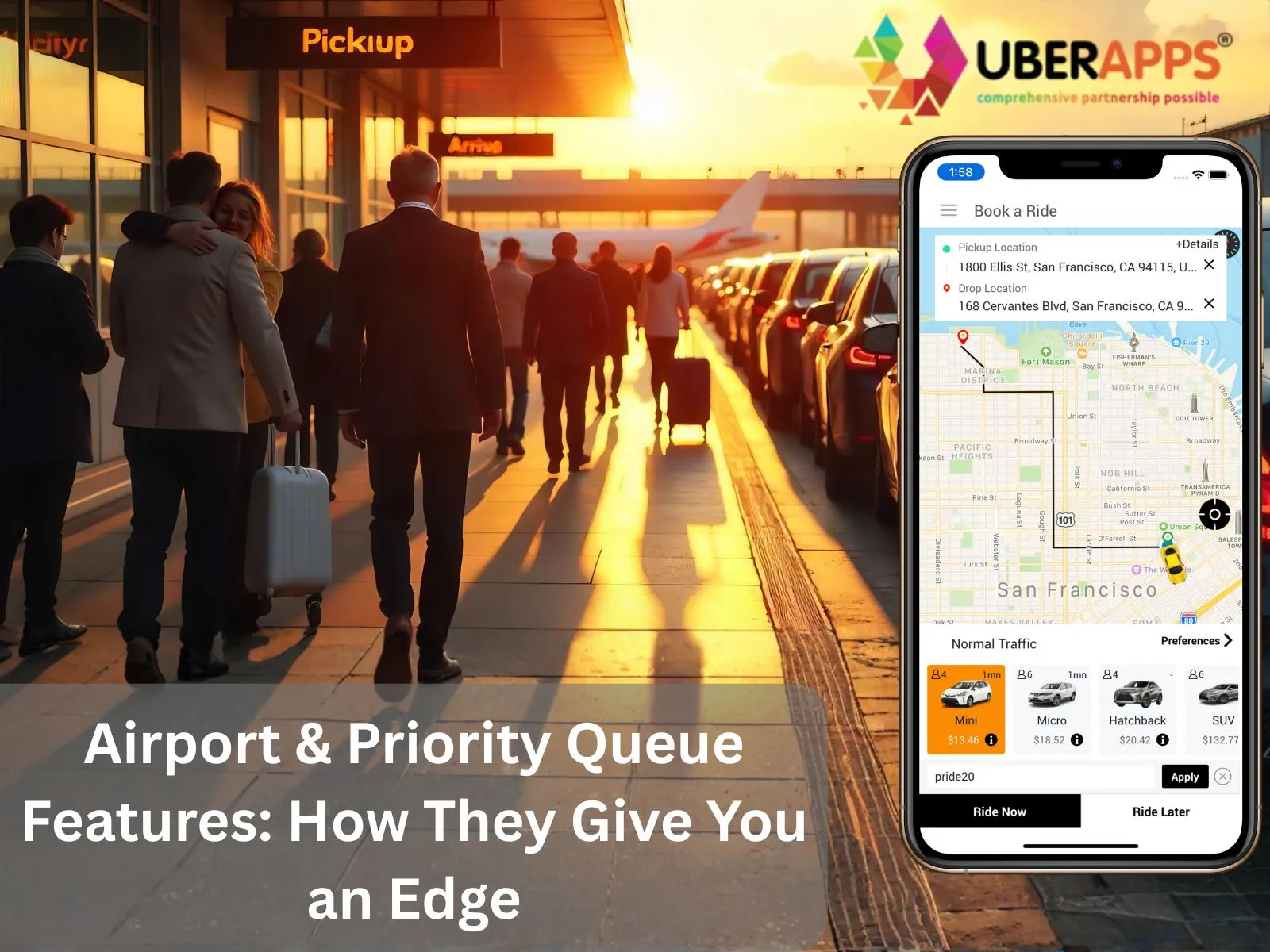
Airport & Priority Queue Features: How They Give You an Edge
In the competitive ecosystem of on-demand transportation, airport transfers represent the "golden mile" of profitability. For drivers, these long-distance trips offer high fares and consistent work; for platform owners, they generate significant commission revenue and brand visibility to international travelers. However, without a robust technological framework, airport pickups can quickly descend into chaos, characterized by traffic congestion, frustrated drivers, and angry passengers unable to locate their rides. This is where advanced taxi app development separates the market leaders from the amateurs.
Implementing a sophisticated Airport and Priority Queue system is not just about organizing cars; it is about mastering supply and demand dynamics in a high-pressure environment. By utilizing virtual geofencing and intelligent algorithms, a modern SaaS taxi app can transform a chaotic curbside into a streamlined, digital marketplace. These features ensure fairness for drivers waiting in lots while providing passengers with seamless, instant bookings. For entrepreneurs investing in Uber clone technology, understanding the nuances of FIFO (First-In-First-Out) versus priority logic is essential.
This guide will explore how these features function technically and operationally to give your platform a decisive competitive edge.
High-value airport rides are the lifeblood of any successful ride-hailing business, but managing the chaos of terminal pickups requires sophisticated technology. "Airport & Priority Queue Features: How They Give You an Edge" is the ultimate guide for entrepreneurs and developers building a SaaS taxi app. We dive deep into the mechanics of virtual queuing, explaining how geofencing creates orderly FIFO (First-In-First-Out) systems that replace physical taxi lines. Beyond the basics, we explore advanced ride-hailing app features like "Rematch" capabilities that reduce driver idle time and "Short Trip Protection" that safeguards driver earnings. The post also details how to monetize these systems through in-app payments for taxi apps, offering priority access as a premium feature. Whether you are customizing an Uber clone or engaged in custom taxi app development, this article provides the technical blueprints to optimize fleet efficiency and dominate the lucrative airport transfer market.
The Strategic Importance of Airport Queue Management
Taming the Terminal Chaos
Airports are unique operational environments with strict regulations, designated staging lots, and high security. Unlike city centers where drivers roam freely, airports require a structured approach. Without a dedicated queue feature, drivers would circle terminals endlessly, wasting fuel and causing congestion, which often leads to platforms being banned by airport authorities. A well-engineered SaaS taxi app solves this by creating a "Virtual Queue."
When a driver enters a designated geofenced area (the staging lot), the app automatically places them in a digital line. This system provides transparency: drivers can see exactly how many cars are ahead of them and their estimated wait time. This visibility reduces driver anxiety and prevents the "wild west" behavior of drivers fighting for passengers at the curb. By digitizing this process, you ensure compliance with airport regulations while optimizing your fleet's efficiency.
High-Value Ride Retention
Airport rides are often the most lucrative trips on a platform, typically commanding 2x to 3x the value of a standard inner-city fare. Consequently, drivers are willing to wait for these trips. However, if your queuing logic is flawed—for example, if a driver waits an hour only to receive a request for a 5-minute trip to a nearby hotel—you risk mass churn.
Effective queue management features, such as "Short Trip Protection" (which we will discuss later), ensure that the reward matches the effort. By guaranteeing fair access to these high-value rides, you build loyalty among your driver partners. In the world of taxi booking apps, retaining a reliable supply of drivers at major transit hubs is critical for user reliability. If a passenger lands and sees "No Cars Available," they will instantly switch to a competitor.
Technical Architecture: Geofencing and FIFO Logic
Implementing Virtual Boundaries
The backbone of any airport queue system is Geofencing. In taxi app development, a geofence is a virtual perimeter defined by GPS coordinates (latitude and longitude) that triggers specific software actions when a device enters or exits the area. For airports, you typically need two distinct geofences: the Staging Lot (where drivers wait) and the Terminal Zone (where pickups happen).
When a driver’s app detects they have entered the Staging Lot polygon, the backend server changes their status to "Queued." It is crucial that this detection is precise; if the GPS drifts, a driver might lose their spot in line, causing immense frustration. Advanced Uber clone scripts use "polygon-in-polygon" logic to handle complex airport layouts, ensuring that drivers are only added to the queue if they are in the correct waiting area, not just driving past on a nearby highway.
The First-In-First-Out (FIFO) Algorithm
The most common and fair method for managing airport queues is the FIFO algorithm. It operates on a simple premise: the first driver to enter the geofence is the first to receive a ride request. This mimics a physical taxi line but exists entirely in the cloud.
From a technical perspective, the backend maintains a list of Driver IDs ordered by entry_timestamp. When a passenger requests a ride from the terminal, the dispatcher creates a "match" with the driver at index 0 of the queue. If that driver declines, the request moves to index 1, and the first driver is penalized (often moved to the back of the line). This clarity is vital for driver trust. They know that if they wait their turn, they will get a job. There is no favoritism, just code-enforced fairness.
Priority Queue Features: The "Secret Sauce" of Profitability
What is a Priority Queue?
While FIFO is fair, it isn't always efficient or profitable. A Priority Queue system allows certain drivers to "jump the line" based on specific criteria. This is a powerful tool in ride-hailing app features because it allows the platform to incentivize desirable behaviors.
In a Priority Queue model, the dispatch algorithm calculates a "Score" for each driver in the lot. The score might be based on their overall rating, their vehicle type (e.g., luxury vans getting priority for large groups), or their recent acceptance rate. Drivers with higher scores are pushed to the front of the virtual line, reducing their wait times significantly. This gamification element encourages drivers to maintain high service standards to unlock "Fast Track" access at airports.
Monetizing Priority Access
Here is where in-app payments for taxi apps intersect with queue logic. You can create a subscription model where drivers pay a monthly fee for "Priority Airport Access." This is a pure profit stream for the platform owner.
Alternatively, you can offer "One-Time Priority Passes" as rewards. For example, if a driver completes 50 rides in a week during peak hours, they earn a "Skip the Queue" pass for the airport. This drives supply during busy times in the city and rewards the driver with a lucrative airport trip later. This strategic use of priority queuing transforms a logistical necessity into a powerful retention and revenue engine.
Advanced Dispatch Features: Rematch and Re-Dispatch
The "Rematch" Efficiency Booster
One of the biggest inefficiencies in traditional airport taxi logistics is the "Deadhead" mile—driving empty. Typically, a driver drops a passenger off at the departure terminal and then has to drive all the way to the staging lot to wait for a new ride. This wastes time and fuel.
The "Rematch" feature changes this. It uses a predictive algorithm to identify drivers who are about to complete a drop-off at the terminal. If there is high demand at arrivals, the system instantly matches this driver with a new passenger before they leave the terminal zone. This allows the driver to perform a "Drop-off and Pick-up" in one smooth loop, bypassing the staging lot entirely. For the platform, this increases the number of completed rides per hour; for the driver, it maximizes earnings per hour.
Preventing Abuse of Rematch
To prevent drivers from looping the airport endlessly to game the system, taxi app development teams implement strict logic gates. For example, Rematch might only be active for 45 seconds after a drop-off is completed. If the driver doesn't get a ride in that window, they must proceed to the staging lot.
Additionally, Rematch is often usually only enabled during peak hours when the number of arriving passengers exceeds the number of drivers in the queue. This dynamic activation ensures that the drivers waiting in the staging lot are not completely starved of work, maintaining a balance between efficiency for active drivers and fairness for waiting ones.
Short Trip Protection: A Critical Driver Safety Net
The Frustration of the "Short Ride"
Imagine a driver waits two hours in an airport queue, expecting a $50 fare to the city center, but receives a request for a $5 ride to a car rental location just outside the airport. In a strict FIFO system, this driver would lose their spot and have to go to the back of the line—another two-hour wait. This is a leading cause of driver aggression and cancellation.
How Short Trip Protection Works
To solve this, leading taxi booking apps implement "Short Trip Protection." If a driver completes a ride that is below a certain distance or time threshold (e.g., less than 15 minutes), the system recognizes this as a "Short Trip."
When the driver returns to the airport geofence within a specific timeframe, the algorithm identifies their ID and automatically places them back at the front of the queue, or heavily boosts their priority position. This feature acts as an insurance policy for drivers. It reassures them that accepting a short trip won't ruin their day's earnings. Implementing this requires precise logic in the backend to track ride duration and return intervals, but the payoff in driver satisfaction is immense.
In-App Payments and Surcharges in Airport Zones
Automating Airport Fees
Airports almost always charge commercial vehicles a fee for picking up or dropping off passengers. Managing this with cash is slow and prone to theft. A robust SaaS taxi app automates this entirely.
Using the geofence data, the app detects when a pickup occurs within the airport zone. The backend automatically adds the airport surcharge to the passenger's final fare. This fee is then either remitted directly to the airport authority (if an API integration exists) or reimbursed to the driver if they paid it at the gate. Seamless in-app payments for taxi apps handle this complexity in the background, ensuring the passenger sees a transparent breakdown of the fare (Base Fare + Airport Fee + Tolls) on their digital receipt.
Dynamic Pricing at Terminals
Airports are subject to massive spikes in demand when multiple wide-body aircraft land simultaneously. Your queue system must be linked to your Dynamic Pricing (Surge) engine.
When the ratio of passengers to queued drivers exceeds a certain threshold, the app should trigger surge pricing specifically for the airport geofence. This higher price incentivizes more drivers to drive toward the airport staging lot, replenishing the queue. Conversely, if the queue is overflowing with cars, the app can offer discount promotions to passengers to stimulate demand and clear the lot. This self-regulating marketplace is the hallmark of a mature Uber clone.
Technical Implementation for Developers
Database Considerations
When building these features, your database needs to handle high-frequency write operations. The "Queue" table changes every second. Using an in-memory data store like Redis is often preferred over traditional SQL databases for managing the real-time queue position. Redis allows for lightning-fast ranking and retrieval of driver IDs, which is essential when hundreds of drivers are moving in and out of geofences simultaneously.
Handling "GPS Drift" and "Spoofing"
A common issue in taxi app development is drivers using fake GPS apps to make the system think they are in the airport queue while they are actually sitting at home. To combat this, your app needs "Anti-Spoofing" protocols.
This involves checking the "Mock Location" flag on Android devices and validating GPS timestamps. Furthermore, you can implement a "Heartbeat" check where the driver's app must ping the server with valid coordinates every 30 seconds to maintain their position in the queue. If the signal is lost or jumps unrealistically, the driver is removed. This ensures that the queue remains fair for the honest drivers who are physically present.
Conclusion
The difference between a generic taxi script and a market-leading SaaS taxi app lies in the details of operational workflows. Airport and Priority Queue features are not just "nice-to-have" add-ons; they are essential infrastructure for any serious ride-hailing business. They solve the physical problems of traffic and congestion using digital logic, transforming a potential bottleneck into a streamlined revenue stream.
By implementing strict Geofencing, fair FIFO algorithms, and intelligent Rematch capabilities, you respect your drivers' time and your passengers' need for reliability. Furthermore, leveraging in app payments for taxi apps to automate surcharges and monetize priority access adds layers of profitability to your business model. As you embark on your journey of taxi app development, remember that the airport is the ultimate stress test for your platform. If you can make the airport experience smooth, efficient, and profitable, you have built a system that can succeed anywhere.
At UberApps.tech, we understand that these features are complex to build from scratch. That is why our solutions come pre-loaded with advanced queue management logic, designed to give you that critical edge from Day One.
FAQS
1. What is the difference between FIFO and Priority Queues in taxi apps?
FIFO (First-In-First-Out) queues assign jobs to drivers in the order they arrive. Priority Queues let specific drivers skip ahead based on criteria like ratings, vehicle type, or subscription status, incentivizing better service or monetizing tiers.
2. How does the 'Rematch' feature work in ride-hailing apps?
Rematch lets a driver who just dropped off an airport passenger receive a new pickup request immediately, avoiding queue reentry. This reduces empty miles and speeds up curbside clearance, usually enabled during peak demand.
3. How does Geofencing help in airport taxi management?
Geofencing creates a virtual airport boundary. When drivers enter, GPS triggers automatic queue entry, preventing road congestion and ensuring designated waiting areas are used.
4. Can I monetize the queue system in my Uber clone app?
Yes. You can offer "Premium Driver" subscriptions for priority queue access or charge passengers a "Priority Pickup" fee to bypass wait times, leveraging in-app payments to increase revenue.
5. What is Short Trip Protection?
Short Trip Protection safeguards drivers who get short, low-value rides after waiting long in a queue. The system lets them return to the front of the airport queue immediately rather than the back.
Author's Bio

Vinay Jain is the Founder of UBERApps and brings over 10 years of entrepreneurial experience. His focus revolves around software & business development and customer satisfaction.