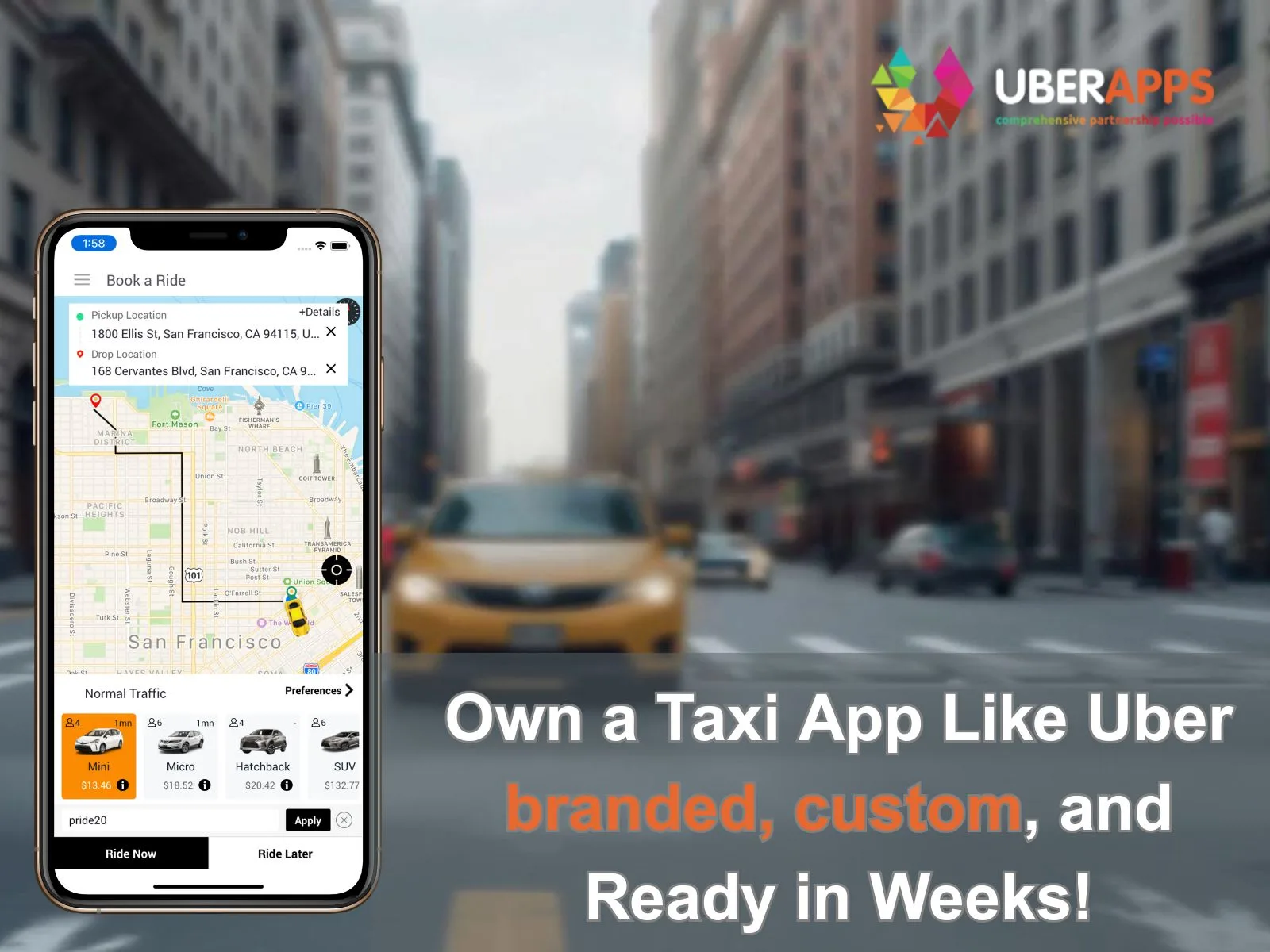
Own a Taxi App Like Uber — Branded, Custom, and Ready in Weeks!
In today’s mobility ecosystem, ride-hailing is no longer the domain of just one player. If you’re in the taxi or transport business, launching your own uber clone-style app can give you serious competitive edge. With a custom taxi booking app, you control your branding, your driver network, and your growth trajectory without being at the mercy of another platform. This is not just about copying Uber; it’s about leveraging proven taxi app development practices and delivering a seamless experience to riders and drivers alike.
In this blog we’ll explore how you can own a taxi app like Uber: branded, custom-built, and ready to launch in weeks—not months.
Are you ready to launch your own taxi app like Uber? In this post we walk you through how your business can deploy a branded, custom taxi-booking app, crafted from a white-label or tailored solution, and go live in just weeks, not months. We’ll unpack what makes an Uber clone successful, the core features your ride-hailing app must include, how to integrate in-app payments for taxi apps, and the key steps of taxi app development. Whether you’re a local taxi operator, a startup entrant into mobility, or an established business looking to pivot, you’ll learn how to validate your idea, choose the right development approach, and hit the market rapidly. With high-volume keywords like “taxi booking apps”, “ride-hailing app features” and “uber clone” woven throughout, this post is SEO-optimized for visibility. Read on to discover how to power up your taxi business digitally—with your own brand, your own app, your own way.
Why Launch a Branded Taxi App (Uber Clone) for Your Business
Market Opportunity in Ride-Hailing
The on-demand taxi booking industry continues to grow rapidly. According to recent research, taxi booking apps are projected to hit huge valuations in the next few years. Starting early with your own branded solution gives you a first-mover advantage in your market region.
Benefits of a Custom Taxi Booking App
When you go with a branded, custom-built solution instead of relying on third-party platforms, you gain:
- Full control of your brand identity and rider experience
- Tailored features to your market (e.g., local payment methods, language, region specific needs)
- Ownership of your data, drivers and customer relationships
- Faster deployment via white-label/clone solutions that reduce time-to-market
Bold takeaway: A branded taxi app gives you independence and differentiation in a competitive ride-hailing landscape.
Typical Challenges Without Your Own App
If you depend solely on aggregators or third-party platforms you may face:
- High commission or dependency costs
- Limited customization or branding options
- Less control over driver onboarding, retention and service quality
- Slower innovation or feature rollout cycles
Going your own way lets you sidestep these hurdles and build a stronger foundation for long-term growth.
Core Features of a Taxi Booking App Like Uber
Rider-Side Features
For riders, your app must deliver ease, speed and reliability. Key features include:
- User registration & profile management
- Booking interface: pick-up / drop location selection via map
- Real-time driver tracking and estimated time of arrival (ETA)
- Fare calculation and ride option selection (economy, premium, etc)
- In-app payments and payment methods (see next section)
- Ride history, receipts and ratings
- Push notifications for ride status updates
These features align with standard ride-hailing expectations.
Driver-Side Features
Your driver app module should include:
- Driver registration and verification (license, vehicle, background)
- Accept/decline ride requests
- Navigation / route guidance and pickup management
- Earnings dashboard and payout history
- Ratings, feedback and driver support
Getting the driver experience right is equally important for your success.
Admin Panel & Business Features
Behind the scenes you need an admin or business panel to manage:
- Ride monitoring and status tracking
- Driver and user management
- Pricing and fare rules setup
- Payments, commissions, payouts and financial reporting
- Analytics and business intelligence to track growth
Bold takeaway: A full stack solution covers rider app + driver app + admin panel for comprehensive control.
In-App Payments for Taxi Apps – A Competitive Advantage
Why In-App Payments Matter
In-app payments are now a standard expectation: riders want seamless checkout, drivers want reliable payouts, and businesses want transparency. Having built-in payment methods reduces friction, improves user satisfaction and enhances monetization.
Payment Options & Monetization Models
You'll want to support:
- Credit/debit cards
- Digital wallets (depending on region)
- In-app wallet or stored value systems
- Post-ride payment options (cash fallback)
Also consider how you monetize:
- Commission per ride
- Surge pricing or peak pricing
- Subscription or membership models for drivers or riders
Bold takeaway: In-app payments are both a feature and a revenue stream.
Security & Compliance Considerations
Make sure your solution handles:
- Payment gateway integration securely (PCI compliance)
- Local currency and tax regulations
- Driver pay-out workflows and financial reconciliation
- Fraud prevention, chargebacks and secure transactions
Getting these right builds trust among riders and drivers alike.
Taxi App Development – Speed to Market & Best Practices
Choosing White-Label vs Fully Custom Development
If you want to launch quickly, a white-label or clone script is a strong option. According to industry guides:
- You save significant development time and cost
- Customization is still possible (branding, colours, features)
Steps for white-label:
- Choose template/clone provider
- Apply your branding (logo, colours, name)
- Configure features and integrate local payment options
- Test across riders, drivers and admin panel
- Launch on app stores
Typical Development Timeline
A basic MVP (minimum viable product) taxi app can be developed in weeks to a few months, especially when using pre-built modules.
Key Development Checklist
Here's a quick checklist to help guide your project:
- Define your unique value proposition and target market
- Perform competitive and market research
- Select platform(s) (iOS, Android, Web)
- Choose whether white-label or custom
- Integrate core features (booking, payments, tracking)
- Onboard driver network and test workflows
- Launch pilot and iterate based on feedback
Bold takeaway: A structured checklist keeps your taxi app development on track and avoids delays.
Deployment & Growth Strategies
Once developed, you'll need to:
- Publish the rider and driver apps on app stores and ensure app‐store optimization (ASO)
- Market your app through digital channels, social media, local partnerships
- Onboard drivers quickly and ensure smooth onboarding/training
- Monitor metrics (rides per day, driver retention, revenue) and iterate
- Expand your service area, vehicle types and features over time
Bold takeaway: Launch is just the beginning—growth comes from planning beyond development.
Best Practices for SEO & Online Visibility of Your Taxi App
Keyword Strategy & Content Optimization
Since you're reading this on your website www.uberapps.tech, using keywords like uber clone, taxi app development, taxi booking apps, ride-hailing app features, and in-app payments for taxi apps with sensible frequency can help your post rank higher. Research shows these are high-volume keywords in this niche.
Local SEO & Target Market Considerations
If your taxi app targets a specific region, don't ignore local search. Use local keywords, mention city/area names, support Google Business Profile, local directories and map listings.
Content Quality & Readability
Good content is still king:
- Keep paragraphs short (10-15 sentences max)
- Use headings (H1, H2, H3, H4) to structure the post
- Use bullet lists for steps or tips
- Highlight bold key takeaways to engage readers
- Use natural, conversational tone
Bold takeaway: SEO isn't just about keywords—readability, structure and user experience matter a lot too.
Conclusion
Launching your own taxi app like Uber is no longer a dream it's a tangible business move you can execute with the right approach. By choosing a branded, custom solution and focusing on taxi app development, you gain control, differentiation and speed. Starting with proven modules (an uber clone script) reduces cost and time, while still giving you the customization your market needs. Focus on delivering top-notch rider and driver experiences, integrate seamless in-app payments for taxi apps, and equip yourself with a full admin panel for ongoing growth.
Combine that with solid SEO and online marketing centred on keywords like "taxi booking apps" and "ride-hailing app features", and you're set for visibility. Remember: launch fast, iterate constantly, and scale smartly. With the right foundation, your taxi app can become the go-to mobility solution in your region something built for your brand, your business model, and your future.
UBERApps Technologies stands as a pioneer in transforming mobility through innovation, precision, and speed. With a strong focus on building scalable, branded taxi apps, UBERApps empowers entrepreneurs and enterprises to launch market ready ride-hailing solutions in just 1 weeks. The company combines cutting-edge technology with deep industry insight, delivering white-label taxi apps that are intuitive, secure, and built to perform under real-world demands.
From advanced GPS tracking and seamless payment integrations to custom branding and analytics-driven dashboards, every solution from UBERApps is crafted to redefine the user experience. Their agile development approach ensures faster deployment without compromising on quality—allowing businesses to capture opportunities in the rapidly evolving mobility landscape.
More than just an app developer, UBERApps Technologies acts as a strategic technology partner, guiding clients from concept to launch and beyond. With expertise across platforms and global markets, they enable taxi businesses to scale effortlessly, adapt to local needs, and lead with innovation.
In a world where speed, reliability, and brand identity determine success, UBERApps delivers the complete package empowering startups and established companies alike to drive the future of transportation with confidence.
FAQS
1. What services does UBERApps Technologies offer?
UBERApps specializes in developing white-label taxi apps, including rider, driver, and admin modules.
2. How long does it take to launch a taxi app with UBERApps?
Typically, clients can launch a fully branded taxi app within 3–5 weeks.
3. Can the app be customized to match my brand?
Yes, every UBERApps solution is tailored with your logo, colors, and brand identity.
4. Does UBERApps provide post-launch support?
Absolutely. UBERApps offers maintenance, updates, and ongoing technical support.
5. Are the apps suitable for global markets?
Yes, UBERApps apps include multilingual and multi-currency support for international deployment.
Author's Bio

Vinay Jain is the Founder of UBERApps and brings over 10 years of entrepreneurial experience. His focus revolves around software & business development and customer satisfaction.