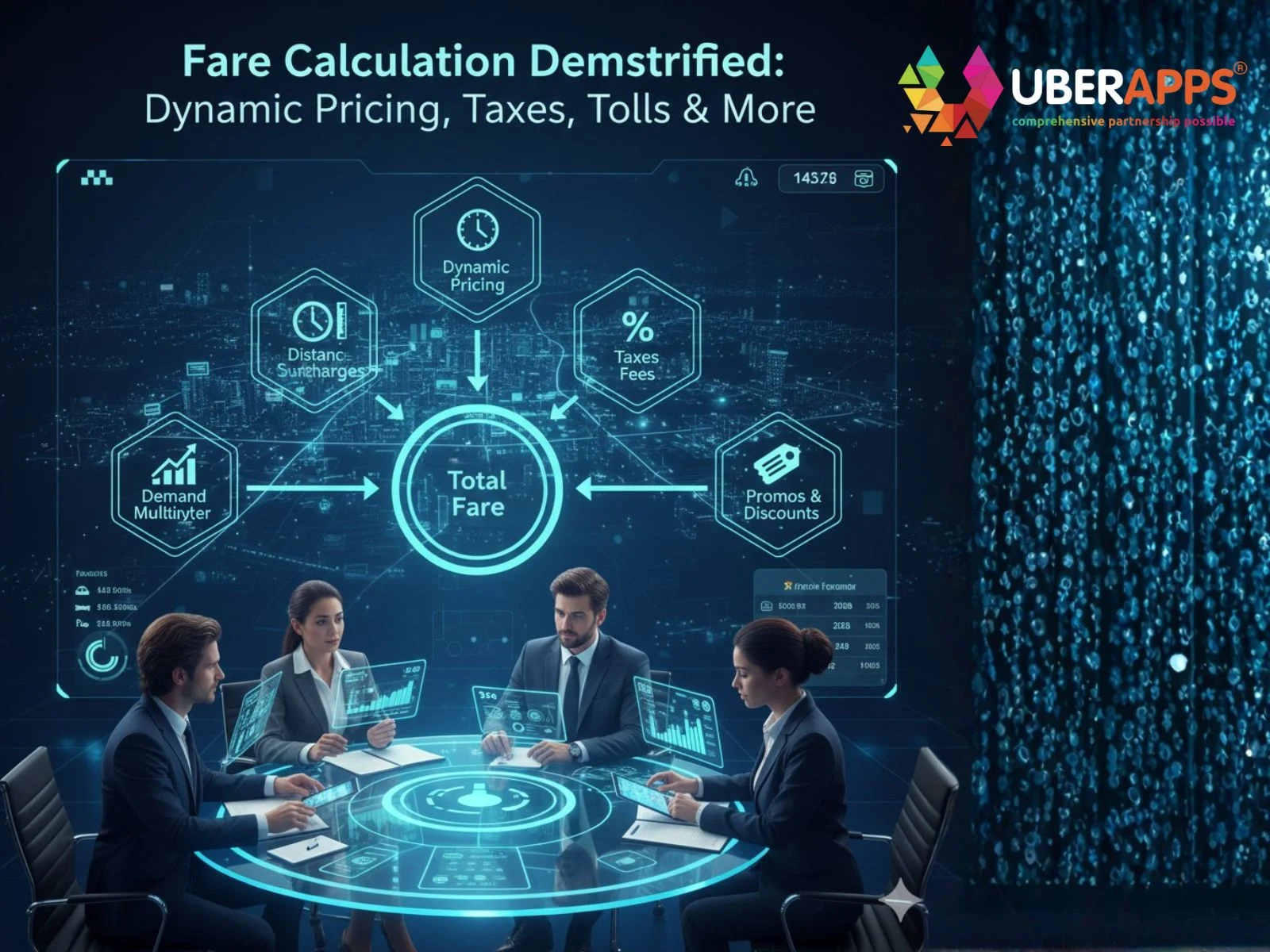
Fare Calculation Demystified: Dynamic Pricing, Taxes, Tolls & More
Every time a user opens a taxi booking app and requests a ride, a complex mathematical equation is solved in milliseconds to generate an upfront price. For the passenger, it’s a matter of convenience; for the company, it’s the core of their business model. This calculation is far more intricate than simply multiplying distance by a per-kilometer rate.
It is a carefully orchestrated blend of fixed costs, variable components, and real-time market forces. To build a successful Uber clone, understanding this multi-faceted fare calculation engine is non-negotiable.
This comprehensive guide will take a deep dive into every element that contributes to the final fare you pay, from the foundational base rate to the advanced algorithmic adjustments of dynamic pricing, ensuring you have the knowledge to create a profitable and transparent taxi app development strategy.
We'll explore how these elements combine to define the profitability and user experience of modern ride-hailing platforms.
The seemingly simple act of booking a ride on a taxi booking app involves a highly complex and sophisticated algorithm that instantly calculates your trip's cost. This 2200-2500-word guide, tailored for anyone interested in taxi app development, pulls back the curtain on this process. We’ll dissect the core components of the fare, starting with the fundamental base fare and the rates tied to distance and time. A significant focus will be on the game-changing concept of Dynamic Pricing how demand, supply, traffic, and even weather can instantly alter your price, a critical feature for any successful Uber clone. Furthermore, we explore the often-overlooked factors like government taxes, city-specific surcharges, bridge/tunnel tolls, and various fees that contribute to the final amount. Finally, we'll cover the crucial role of in-app payments for taxi apps in ensuring seamless transaction processing. Understanding this mechanism is vital for building a competitive and profitable ride-hailing business.
The Foundation: Core Components of Taxi App Fare Calculation
The final cost of a trip in any modern ride-hailing application, including an Uber clone, begins with a set of standardized, fixed, and variable components. These fundamental rates ensure that every trip covers the essential operational costs, driver compensation, and platform revenue. Without a solid, well-defined basic structure, the entire pricing model would be unsustainable. Establishing clear, competitive, and geographically relevant rates is the crucial first step in any taxi app development project.
The Base Fare and Minimum Price: Non-Negotiable Starting Points
The base fare is the static, non-negotiable amount charged to the user at the very beginning of every trip. It serves as a fixed minimum charge to cover the basic costs of the driver initiating the ride, regardless of how short the distance is. This ensures that even the shortest trips are profitable for the driver and the platform.
Understanding the Minimum Trip Price
While the base fare is the initial entry point, the Minimum Trip Price is the lowest amount a passenger will be charged for completing a ride. In many cases, if the combined total of the base fare plus distance and time rates falls below a set threshold, the minimum price acts as the final floor. This guarantees a basic level of earnings for the driver, making short, quick trips worthwhile. For taxi booking apps, this feature is vital for retaining drivers in high-density, low-distance urban centers.
Distance and Time Rates: The Variable Core
The bulk of the trip cost is determined by two major variable factors: the distance traveled and the time taken. These rates are dynamic, changing based on the specific city, vehicle type (e.g., Sedan, SUV, Luxury), and local economic conditions.
Per-Kilometer/Mile Rate
This is the charge applied for every unit of distance the vehicle travels from the pickup point to the drop-off location.
- The rate is typically defined in the administrative panel of an Uber clone platform.
- It directly compensates the driver for fuel consumption, vehicle wear and tear, and time spent on the move.
- In some regions, the rate may change after a certain distance threshold is crossed (e.g., a lower rate for trips over $100$ kilometers).
Per-Minute Rate for Trip Duration
The per-minute rate, often referred to as the "waiting time" or "trip duration" charge, compensates the driver for the time spent while the vehicle is moving slowly or stopped due to traffic congestion.
- This rate is critical in heavily congested urban areas, where slow movement drastically reduces the number of trips a driver can complete in an hour.
- It ensures that drivers are compensated fairly for their time, even when the vehicle is not racking up distance.
- This rate can also kick in for the passenger’s delay in reaching the pickup spot, known as a 'wait time fee.
Dynamic Pricing: The Engine of a Modern Uber Clone
Dynamic pricing—often sensationalized as "surge pricing"—is the most sophisticated and controversial component of the modern taxi booking app fare system. It is the real-time adjustment of trip costs based on the current balance of supply and demand, ensuring market equilibrium. This feature is a must-have for any competitive Uber clone platform, as it manages the core logistics of driver allocation and service availability.
How Dynamic Pricing Algorithms Work in Ride-Hailing
The algorithm constantly analyzes massive amounts of data in real-time to determine a multiplier that is applied to the standard fare. The primary goal is twofold: to incentivize more drivers to get on the road in areas of high demand, and to temporarily reduce demand from users who are less time-sensitive.
Real-Time Supply and Demand Metrics
The core mechanism revolves around the ratio of riders requesting a trip versus the number of available drivers in a specific geographical zone.
- High Demand, Low Supply: When the number of ride requests significantly exceeds the number of nearby drivers, the dynamic pricing multiplier increases.
- Equilibrium: When supply meets demand, the multiplier is typically set to $1.0$ (no surge).
- Driver Incentive: The increase in fare immediately signals to nearby, off-duty drivers that it is financially beneficial to log in and start accepting rides, quickly addressing the supply shortage.
External Factors Influencing Dynamic Pricing
Dynamic pricing is not solely based on the current number of pings and cars. A truly sophisticated taxi app development platform will integrate a wide array of external data points to predict and justify price shifts.
- Weather Conditions: Heavy rain, snow, or extreme heat/cold often lead to a spike in ride requests and, consequently, higher fares. The algorithm accounts for this weather-induced surge in demand.
- Time of Day and Week: Peak hours (e.g., morning and evening commutes), weekend nights, and holidays are predictable periods of high demand where dynamic pricing is likely to be activated.
- Special Events: Concerts, major sporting events, festivals, or local closures (like subway outages) create localized demand spikes. Geofencing is used to identify these zones and apply temporary surcharges.
- Traffic Congestion: While the per-minute rate covers some of this, severe gridlock can trigger dynamic pricing, as the longer trip time means a higher opportunity cost for the driver.
Transparency and Fairness in Dynamic Pricing
While essential for operational efficiency, surge pricing is often a point of contention for users. Building a transparent system is key to maintaining trust and user retention for an Uber clone.
- Upfront Pricing: Modern apps use advanced algorithms to calculate the final upfront price, including any dynamic surge, before the user confirms the booking. This eliminates sticker shock.
- User Notification: The app must clearly notify the user that dynamic pricing is in effect, often by displaying the multiplier (e.g., "Price is 1.5x higher due to high demand").
- In-App Feature: A toggle or a button allowing the user to check back later when prices drop can empower the user, fostering a sense of control over the fare calculation process.
Taxes, Tolls, and Fees: The Regulatory Cost Layer
Beyond the operational costs, a significant portion of the final fare comprises various governmental and regulatory charges. These elements often change based on jurisdiction and must be accurately integrated into the fare calculation logic for the taxi booking app to remain compliant and profitable.
Governmental Taxes and Surcharges
Every country and sometimes every state or city imposes different taxes and regulatory fees on ride-hailing services. A robust taxi app development solution must handle these complexities seamlessly.
Sales Tax, VAT, and Service Tax
These are consumption taxes applied as a percentage of the total trip fare.
- Calculation: The system calculates the base fare, distance, time, and dynamic price, and then applies the mandated tax rate on the final subtotal.
- Compliance: The system must be able to generate and submit detailed records of these transactions to the appropriate tax authorities, a critical function managed by the admin panel.
Local and City-Specific Surcharges
Many metropolitan areas levy specific fees on ride-hailing trips to address local issues like congestion or to fund public transit.
- Congestion Fees: Charged for trips originating or terminating within a specific high-traffic zone (e.g., a downtown business district) during peak hours.
- Airport/Venue Fees: Surcharges applied for pickups or drop-offs at major hubs like airports, railway stations, or large event venues, often used to pay for the right to operate on that property.
Tolls and Road-Use Fees
Tolls for bridges, tunnels, and certain highways are a direct cost of the trip that must be passed on to the passenger.
Automatic Toll Integration
Modern Uber clone apps integrate with mapping and toll authority APIs to provide an accurate estimate of toll charges in the upfront price.
- Pre-Trip Estimation: The estimated toll is included in the fare shown to the user before they book.
- Post-Trip Adjustment: If the driver takes a route with a different toll structure (e.g., takes a cash-only lane vs. an electronic transponder lane, or if the estimated toll was incorrect), the final fare is typically adjusted on the receipt to reflect the actual cost incurred.
In-App Payments for Taxi Apps: Closing the Loop
The final stage of the fare calculation process is the transaction itself. The success of ride-hailing is built on the convenience of seamless, cashless in-app payments for taxi apps. This requires secure integration with reliable payment gateways and a system that can accurately handle all the complex fare components.
Secure Payment Gateway Integration
Integrating multiple, secure payment gateways is essential for a global or even a local taxi booking app.
- Credit/Debit Cards: The system must securely store card information (tokenization) and process charges instantly upon trip completion.
- Digital Wallets: Integration with popular local and international wallets (e.g., Apple Pay, Google Pay, PayPal, Paytm, UPI) broadens user accessibility.
- In-App Wallet: Many platforms allow users to preload an in-app wallet, which offers the fastest transaction and can be used for promotional credits or refunds.
The Commission and Driver Payout
The final calculated fare is split between the platform (commission) and the driver (earnings), all managed through the in-app payments for taxi apps feature.
- Automatic Deduction: The platform's commission, which is a fixed percentage of the net fare (after taxes and tolls are passed through), is automatically deducted before the payout is credited to the driver’s in-app account. This is a primary revenue stream for the Uber clone.
- Transparency: Drivers receive a detailed earnings statement for every trip, clearly showing the base fare, distance/time earnings, dynamic pricing multiplier, taxes collected, tolls reimbursed, and the platform’s commission.
Taxi App Development: Building a Smart Fare Engine
For developers looking into taxi app development, the fare calculation engine is the most challenging yet crucial part of the project. It needs to be scalable, fast, and highly customizable to adapt to different regional regulations and business strategies.
Key Technical Features for Fare Management
A world-class fare engine in an Uber clone needs specific features to manage complexity and ensure a positive user experience.
- Geo-Fencing and Rate Zones: The ability to define specific geographical zones (e.g., 'Downtown Area', 'Airport Zone') and automatically apply different rates, taxes, or surcharges within those boundaries.
- Route Optimization APIs: Integration with APIs like Google Maps or OpenStreetMaps to get highly accurate estimations for trip distance, duration, and traffic conditions in real-time.
- Promo Code and Discount Engine: A flexible system to apply one-time, percentage-based, or fixed-amount discounts either to the entire fare or specific components (like the base fare), and ensuring the correct party (platform or driver) bears the cost of the promotion.
- Fare Adjustment Logic: A system for the admin or support staff to manually review and adjust a fare post-trip due to unforeseen circumstances, such as a driver taking a significantly longer route or an issue with the mapping system.
Customization for a Competitive Edge
A successful taxi booking app doesn't just copy an existing model; it customizes the fare structure to win over local riders and drivers.
- Tiered Vehicle Pricing: Offering different service tiers (e.g., 'Economy,' 'Premium,' 'Shared') each with its own distinct base fare and per-mile/per-minute rates.
- Subscription Models: Implementing a feature where users can pay a fixed monthly fee to get a percentage off all their rides, effectively lowering the cost per trip and boosting user loyalty.
- Cancellation and No-Show Fees: Clearly defined, automated fees charged to the user if they cancel after a set time or if the driver waits past a certain limit. This is a mechanism to respect the driver's time and operational costs.
Conclusion: Mastering the Complexity for Success in Ride-Hailing
The complex world of fare calculation is the backbone of the entire ride-hailing industry. It’s a dynamic interplay between fixed operational costs, variable real-time factors like traffic and demand, and the rigid, often-changing structure of governmental taxes and tolls. For any business venturing into taxi app development and aiming to launch a viable Uber clone, mastering this complexity is the path to success.
A well-designed fare engine, powered by sophisticated algorithms, is the secret weapon that ensures drivers are sufficiently incentivized to be on the road, while simultaneously offering riders an upfront, transparent, and competitive price. The seamless integration of in-app payments for taxi apps then closes the loop, converting the complex calculation into a simple, friction-free transaction. Building a transparent, compliant, and highly responsive fare calculation system is arguably the single most important factor in distinguishing a market-leading ride-hailing app from a failed one.
By focusing on these intricate details from dynamic pricing mechanics to global tax compliance—your platform, like our advanced Uber clone solutions, will be positioned to attract both riders and drivers, ensuring profitability and sustainable growth in the competitive on-demand economy.
FAQS
1. What is the main difference between static pricing and dynamic pricing in a taxi app?
Dynamic pricing adjusts the base fare and rates in real-time based on current ride supply and demand, balancing the market. Static pricing uses fixed rates based on distance and time, regardless of external factors like rush hour or weather.
2. How do Uber clone apps handle tolls that were not part of the initial fare estimate?
The fare system usually includes estimated tolls upfront. If an unplanned toll route is taken or the actual toll is higher, the final fare adjusts post-trip with detailed changes shown on the passenger's digital receipt.
3. What is the role of the Base Fare in the overall fare calculation?
The Base Fare is a fixed, mandatory charge added at the start of every ride to cover the driver’s minimal overhead and time, ensuring profitability even for short rides.
4. Are the taxes and surcharges in the final fare kept by the taxi app company?
No. Taxes like VAT and local surcharges are collected by the app but passed on to governmental authorities or venue operators. The app retains only its pre-defined commission on the net fare.
5. Can I customize the dynamic pricing logic when developing my own taxi app?
Yes. Taxi app development solutions offer full customization of dynamic pricing parameters, surge geofencing, and external factor influences like weather on pricing.
Author's Bio

Vinay Jain is the Founder of UBERApps and brings over 10 years of entrepreneurial experience. His focus revolves around software & business development and customer satisfaction.